Here's something that surprises most beginners: the words you'd naturally use to describe your own business are often not the words your customers actually search for.
You might call yourself a "digital marketing consultancy." Your potential customer types "someone to run my Facebook ads." Same need, completely different language. Keyword research is how you close that gap — and it's the single most important step most beginners skip entirely, usually because it feels less exciting than actually writing content or designing a page.
This guide is part of our complete SEO Hub — if you haven't read our What Is SEO? beginner's guide yet, that's a good place to start before this one.
Table of Contents
What Is Keyword Research?
Think of it as market research for the search bar. Before a business opens a shop, smart owners study what people in the area actually want to buy. This is the exact same idea, applied to Google.
Skip this step, and you end up writing content that sounds right to you but matches nothing anyone actually searches for — a page with beautiful writing and zero visitors.
Why It Matters
A few concrete reasons it's worth doing properly:
- It reveals real demand. You stop guessing what people want to know and start seeing actual search volume.
- It uncovers competition levels. Some keywords are genuinely easier to rank for than others — research shows you which.
- It shapes your entire content strategy. Instead of random topics, you build content around what people are provably searching for.
- It saves you from wasted effort. Writing 2,000 words nobody searches for is a bigger waste of time than 20 minutes of research upfront.
Types of Keywords
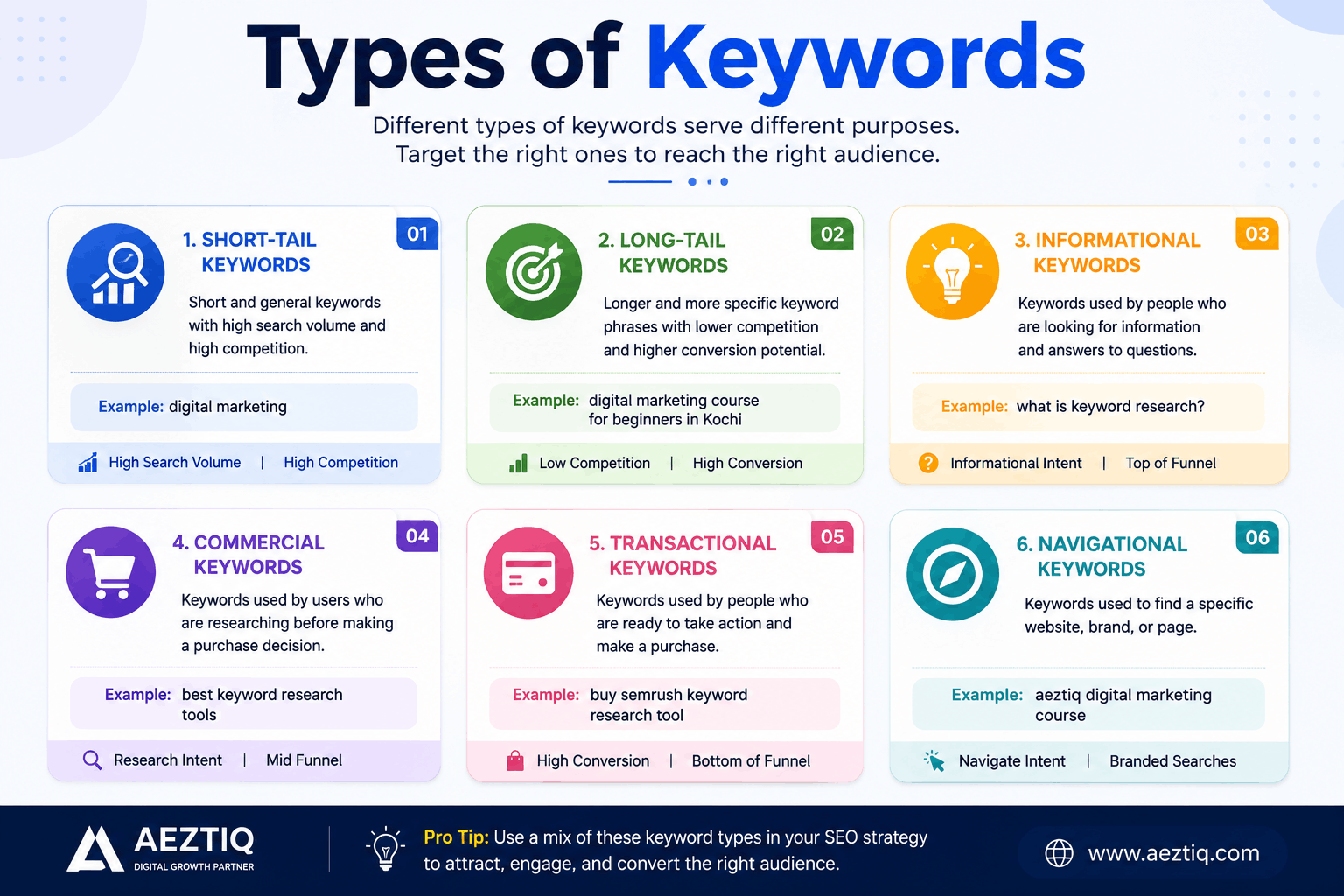
Not all keywords work the same way. Understanding these categories changes how you approach content for each one.
Short-Tail Keywords
Broad, one or two-word searches like "digital marketing" or "SEO." These get massive search volume, but that volume is deceiving — the competition is fierce, and the searcher's actual need is often unclear. Someone searching just "SEO" could be a beginner, a business owner, or a job seeker. You genuinely don't know, which makes it hard to write content that satisfies them all.
Long-Tail Keywords
Longer, more specific phrases like "digital marketing course for beginners in Kerala." Individually, each long-tail phrase gets far less search volume than a short-tail term — but there are vastly more of them, and collectively they often add up to more traffic than chasing one impossible short-tail keyword. More importantly, the person searching a long-tail phrase usually knows exactly what they want, which means higher-quality visitors who are more likely to actually convert.
Informational Keywords
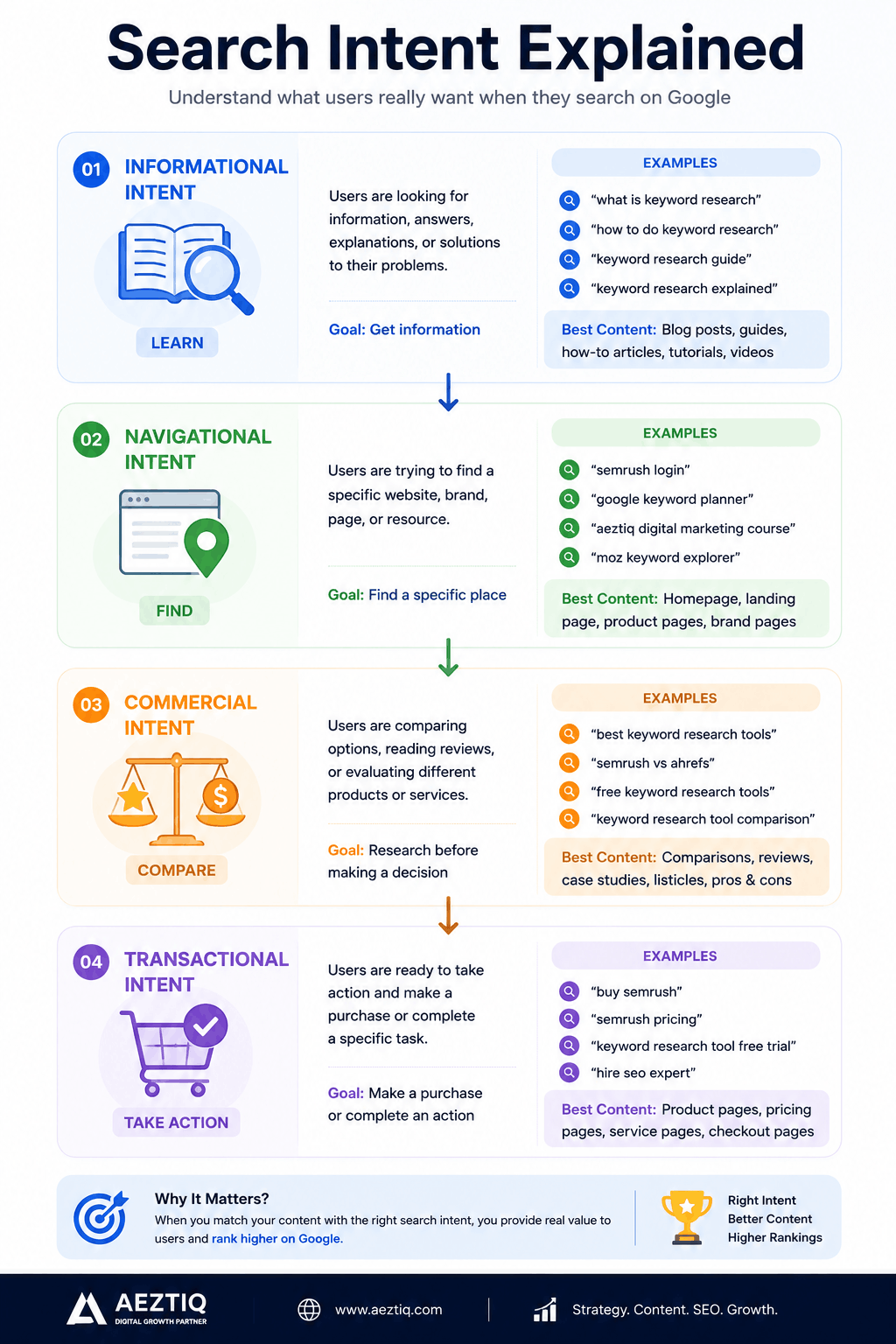
Searches where someone wants to learn something — "how does SEO work," "why is my website not ranking," "what makes a good title tag." These searchers aren't ready to buy yet; they're in research mode. Blog content, guides, and tutorials are the right format here — a hard sales pitch would feel out of place and usually gets ignored.
Navigational Keywords
Searches for a specific brand or website — "AEZTIQ courses," "Facebook login," "Gmail sign in." The person already knows where they want to go; they're just using Google as a shortcut to get there. There's generally little you can do to "compete" for someone else's navigational keyword, but you absolutely want to own your own.
Commercial Keywords
Searches that show comparison-shopping behavior — "best SEO tools," "Semrush vs Ahrefs," "top digital marketing agencies Kerala." The person is evaluating options before deciding, which makes this a valuable moment to appear with genuinely useful comparison content, not just a sales page.
Transactional Keywords
Searches with clear buying intent — "hire SEO agency Kochi," "enroll digital marketing course," "buy SEO services near me." These searchers are ready to take action now. This is where your service pages, pricing pages, and enquiry forms should be doing the heavy lifting — not a long educational blog post.
| Keyword Type | Example | Searcher Intent |
|---|---|---|
| Short-tail | "SEO" | Broad, unclear |
| Long-tail | "SEO course for beginners in Kochi" | Specific, high intent |
| Informational | "How does SEO work" | Learning |
| Navigational | "AEZTIQ courses" | Finding a specific site |
| Commercial | "Best SEO tools 2026" | Comparing options |
| Transactional | "Hire SEO agency Kochi" | Ready to buy/hire |
Notice that last column in the table above — that's search intent, and it matters more than the keyword's exact wording. Matching your content to the right intent is often the real difference between ranking and not ranking, even when the keyword itself is technically the same.
Want Your Keyword Strategy Built by Professionals?
🔍 Explore AEZTIQ's SEO ServicesThe Step-by-Step Process
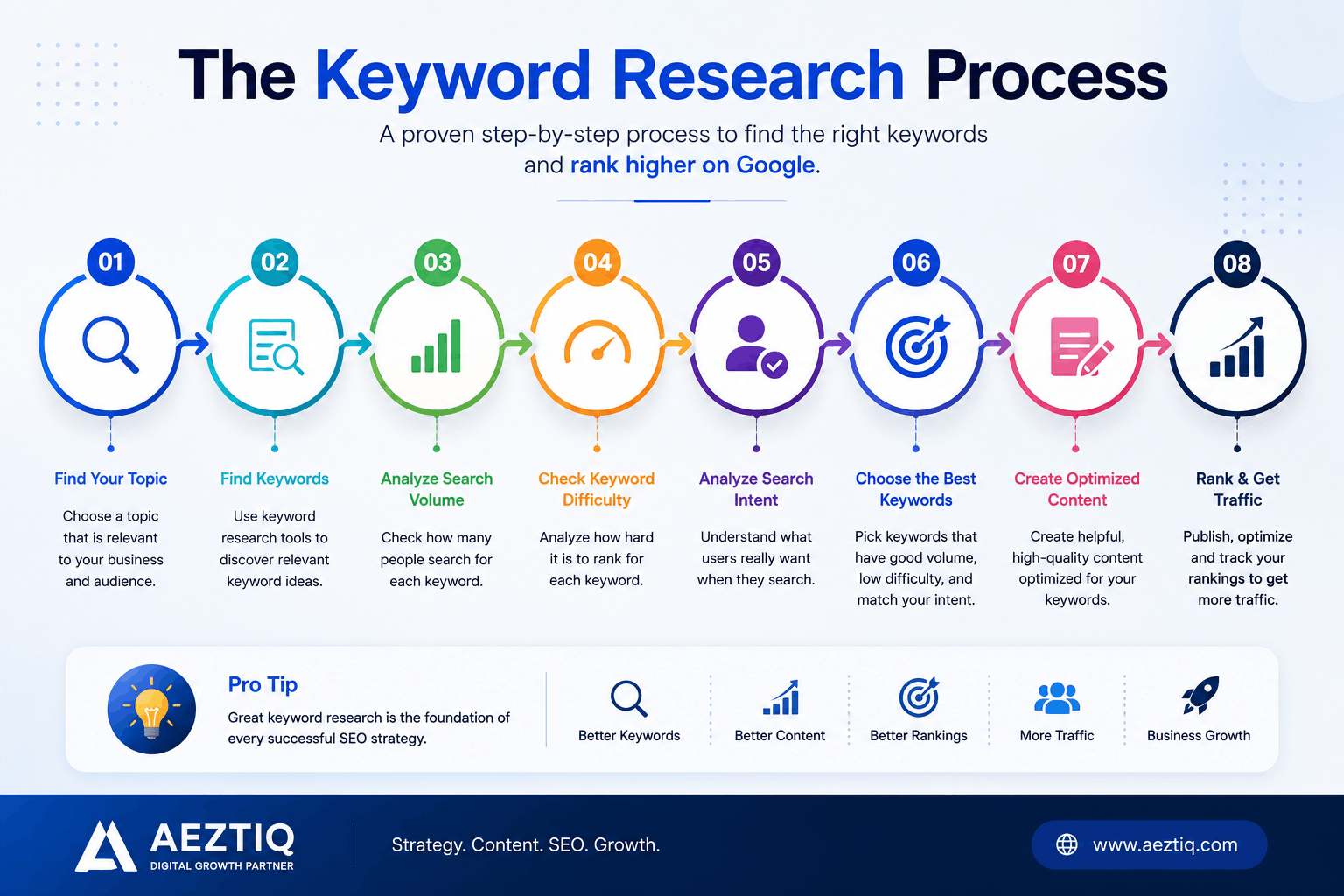
Here's a practical process you can actually follow, not just theory.
- Start with seed keywords. List 5-10 broad terms directly related to your business — the obvious ones first. If you run a digital marketing agency, your seed list might include "digital marketing," "SEO services," "Google Ads management," and "social media marketing." Don't overthink this step; you're just planting the starting points.
- Expand using a keyword tool. Plug your seed keywords into Google Keyword Planner or similar tools to see related terms, search volume, and competition. A single seed keyword can easily expand into 50-100 related suggestions you'd never have thought of manually.
- Check Google's own suggestions. Type your seed keyword into Google and look at autocomplete suggestions and the "People Also Ask" box — both reflect real search behavior happening right now, not outdated data. This is often the fastest way to understand how real people phrase their questions.
- Analyze search intent for each keyword. Search the term yourself and look at what's already ranking — blog posts, product pages, videos, local listings. Whatever format dominates page one is a strong signal of what Google believes searchers actually want.
- Check keyword difficulty. Prioritize keywords you can realistically compete for, especially early on. A brand-new website chasing a keyword dominated by 10-year-old authority sites is fighting an uphill battle it doesn't need to pick right now.
- Group related keywords together. Cluster similar keywords under one page rather than creating separate thin pages for near-identical terms — this is exactly the "hub and cluster" approach this very guide is part of.
- Map keywords to content types. Informational keywords become blog posts; transactional keywords become service or product pages. Matching the right keyword to the right page type is often the difference between a page that ranks and one that doesn't, even with similar content quality.
Search Volume & Keyword Difficulty Explained
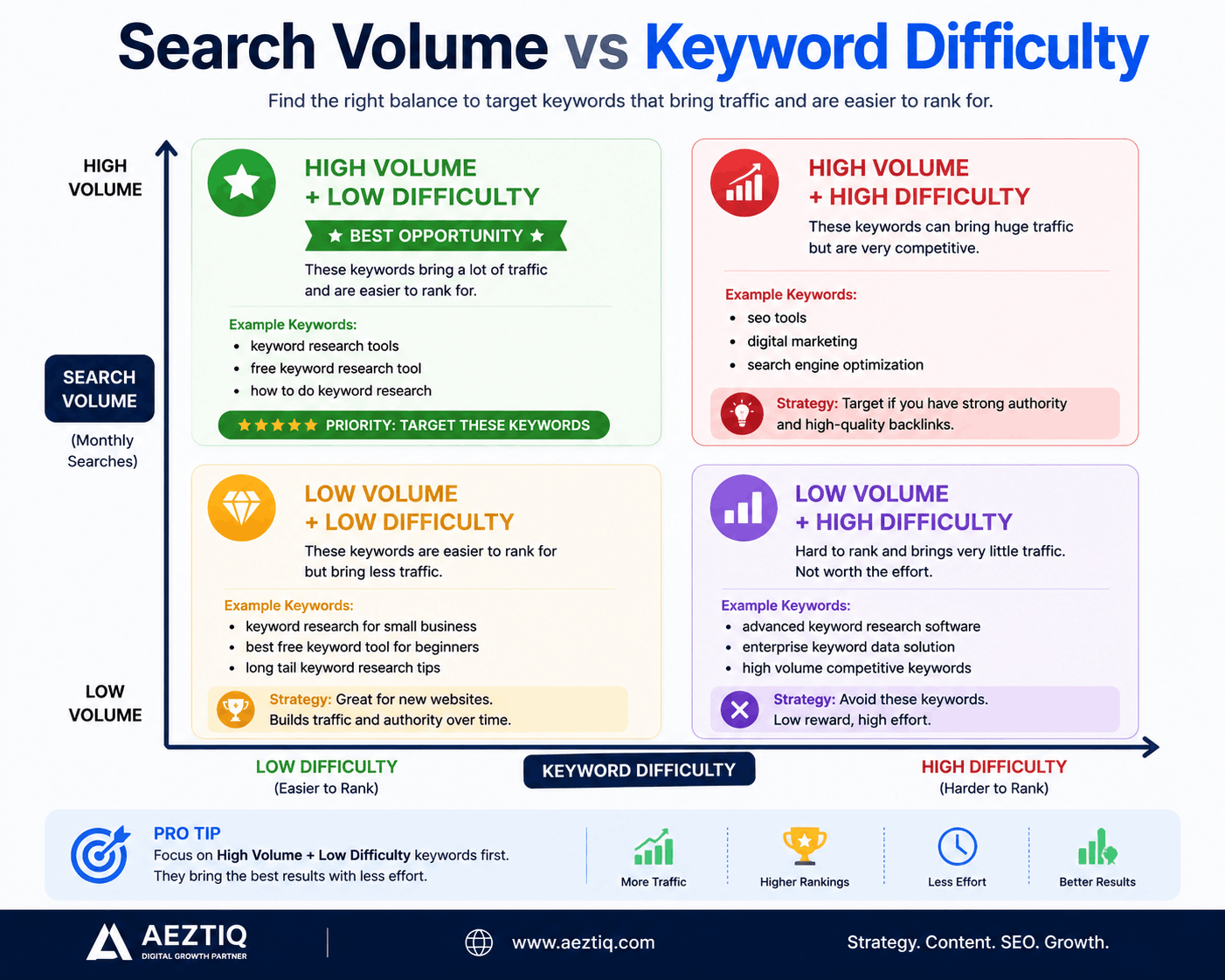
Chasing only high-volume keywords is a common beginner mistake — those are usually the most competitive too. A newer website often has a much better shot at 10 long-tail keywords with lower volume than 1 short-tail keyword with massive volume and equally massive competition.
Keyword difficulty scores (usually shown as a number from 0-100 in most tools) estimate how strong the existing top-ranking pages are — based on their backlinks, content depth, and domain authority. A high difficulty score doesn't mean "impossible," but it does mean you'll likely need significantly more time, better content, and more backlinks than you would for a low-difficulty term.
A practical approach many businesses use: build early authority on achievable, lower-difficulty keywords first, then gradually target higher-difficulty terms as your site's overall authority grows. Trying to skip straight to the hardest keywords before earning that authority is one of the most common reasons new websites struggle to gain any real traction.
How to Analyze Competitor Keywords
One of the fastest ways to find keyword opportunities is to look at what's already working for competitors ranking above you. This isn't about copying — it's about understanding the landscape before you enter it.
- Identify 3-5 real competitors — businesses actually ranking for terms you care about, not just companies you consider competitors offline.
- Run their website through a keyword tool like Ahrefs or Semrush to see which keywords are actually sending them traffic.
- Look for gaps — keywords they rank for that you don't have content for at all. These are often quick wins.
- Study their content structure, not to copy it, but to understand what depth and format Google is already rewarding for that topic.
- Check their weaker rankings — keywords where they rank on page two or three. If you can create noticeably better content, that's a realistic opportunity to outrank them.
Best Tools for the Job
| Tool | Best For | Free or Paid |
|---|---|---|
| Google Keyword Planner | Search volume and keyword ideas | Free (Google Ads account) |
| Google Search Console | Keywords you already rank for | Free |
| Ahrefs | Competitive keyword & difficulty analysis | Paid |
| Semrush | All-in-one keyword and content research | Paid |
| Moz | Keyword difficulty and domain authority scoring | Free tier available |
| AnswerThePublic | Question-based keyword ideas | Free tier available |
Not sure which tools are right for your situation, or want someone to actually run this process for you? Our digital marketing courses cover this hands-on, using these exact tools.
Common Mistakes to Avoid
The Pre-Publish Checklist
- List 5-10 seed keywords related to your business
- Expand seed keywords using a dedicated research tool
- Check Google autocomplete and "People Also Ask" for real phrasing
- Identify the search intent behind each keyword
- Check search volume and keyword difficulty
- Group related keywords under single, focused pages
- Map each keyword group to the right content type
- Prioritize achievable keywords before highly competitive ones
- Revisit and refresh your keyword strategy periodically
Ready to Rank for the Right Keywords?
📈 Get Free ConsultationFrequently Asked Questions
It's the process of finding out what words and phrases people actually type into search engines, so you can create content that matches what they're looking for.
Yes. Even with AI-driven search, understanding real search demand and intent behind queries remains essential for creating content people actually search for.
This depends on your site's authority. New websites generally do better targeting keywords with lower difficulty scores first, then moving to more competitive terms as authority grows.
Short-tail keywords are broad, one or two-word searches with high volume and high competition. Long-tail keywords are longer, more specific phrases with lower volume but higher intent and less competition.
Yes. Google Keyword Planner, Google Search Console, and Google's own autocomplete and "People Also Ask" sections are all free and provide genuinely useful keyword data.
Typically one primary keyword per page, supported by several related secondary keywords that reinforce the same topic. Trying to rank one page for too many unrelated keywords usually backfires.
Search intent is the actual reason behind a search — whether someone wants information, wants to compare options, or is ready to buy. Matching your content to the correct intent matters more than matching the exact keyword wording.
Very low or zero-reported volume doesn't always mean zero real searches — tools often underreport niche or newer queries. It's usually fine to target these if they closely match your business, alongside higher-volume terms.
Conclusion: This Sets Up Everything Else
Every other part of SEO — the content you write, the pages you build, the links you earn — depends on getting this foundation right first. Skip it, and even excellent content struggles to find an audience. Get it right, and you're building on solid ground from day one. If you want to go deeper into Google's own guidance beyond this guide, Google Search Central is the official source worth bookmarking.
The businesses that succeed with SEO aren't necessarily the ones with the biggest budgets — they're often the ones who took the time to actually understand what their customers search for, in their own words, before writing a single page. That's the entire foundation this guide is built around.
Start small: pick 5 seed keywords related to your business today, run them through Google Keyword Planner, and see what you actually find. That alone puts you ahead of most beginners — and it's the exact same first step we walk every student through in our own training programs.
Once your keywords are in place, the next pieces of the puzzle are using them correctly in your content and structure, choosing the right SEO tools to track progress, strengthening your local SEO presence if you serve a specific area, adding schema markup so search engines understand your pages more precisely, and keeping an eye on Core Web Vitals so a slow site doesn't undo all this work. We'll cover each of these in upcoming guides in this series.
Let AEZTIQ Handle Your Keyword Strategy
From strategy to full SEO execution, AEZTIQ helps businesses find and rank for the terms that actually bring customers.
Contact AEZTIQ Today

Johns Kuriakose
Digital Marketing StrategistSpecializes in SEO, Google Ads, Meta Ads, Website Development, and AI-powered marketing — helping businesses improve organic visibility, generate quality leads, and build sustainable online growth.